
All work · Portfolio
The apostle won't be machined
A silver scallop shell designed digitally that, nevertheless, has to be made by traditional techniques. Why?
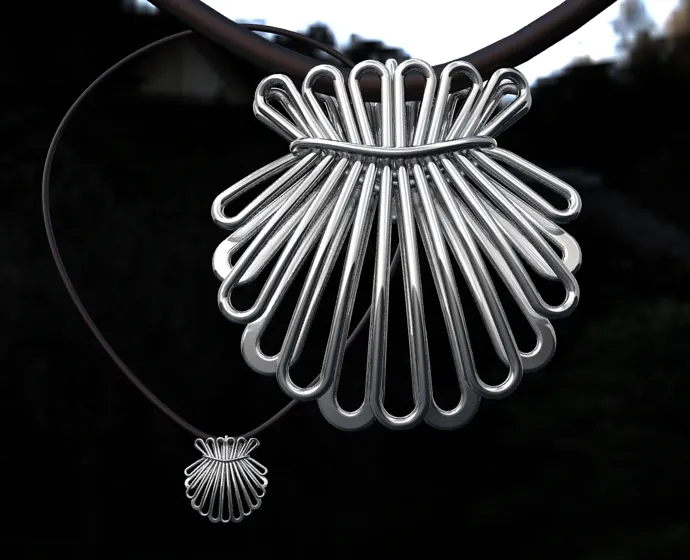
Walkers on the Way to Santiago de Compostela usually carry a scallop shell to symbolise their pilgrimage to the remains of the apostle. The pilgrims’ scallop takes on a spiritual meaning. There are several legends about its origin as a pilgrimage amulet. I will just mention the one I like best, which inspires this design: the ridges of the shell represent paths that set out from different places and converge, radially, on a meeting point. In this case we have digitally designed a silver scallop that, nevertheless, will have to be made by traditional techniques. Why?
This silver scallop differs from a natural scallop shell because it can carry other amulets. The loops of the silver scallop work as a clip, where the pilgrim can fasten other symbolic objects collected along the Way. This means the silver loops must have a certain elasticity, so that they do not bend and they hold the objects clipped to them.
Digital technology is not the right choice here, because it requires 3D prints in wax that are then cast in silver, and the metal of cast pieces has no temper. Without elasticity, the silver scallop will not work as a clip: its loops would give way and bend. We would get a soft, inelastic piece.
It will have to be made by traditional techniques, using a slightly tempered silver wire that is shaped by hand with pliers into the form of the scallop. The wire is tempered beforehand by wire drawing. You start from a wire thicker than the final one, soften it by annealing, and then draw it through draw plates that progressively reduce its section while hardening the metal. The wire must be moderately tempered; otherwise it would snap when shaped.
The digital study of the design lets us estimate the final weight of the piece and judge its aesthetic effect. And it reminds us that there are still designs that are better modelled by hand, and paths that are better travelled on foot.