
All work · Portfolio
Jewels with a fear of mirrors
Yellow and white gold earrings with diamonds, rubies and enamel, and why flat mirror-polished surfaces are so rarely designed.
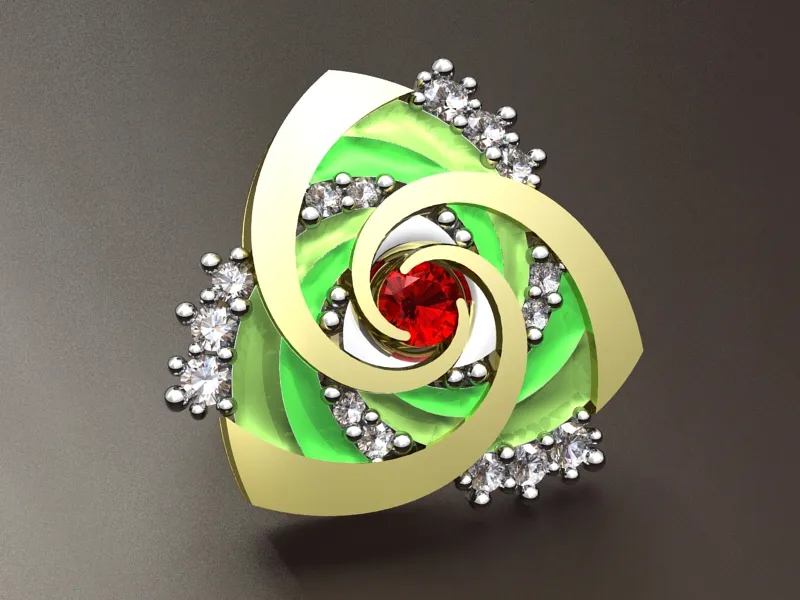
By “mirror” we mean a flat surface with a mirror polish. This design seems to suffer from the same aversion. A pair of polished yellow and white gold earrings (29 grams in total), with 30 brilliant-cut diamonds (1.55 ct in total), two 5.0 mm rubies (about 1.0 ct in total) and enamel.
If we look closely at the yellow gold spirals, we can see that their upper surfaces are slightly concave. We could hide behind aesthetic scruples. Yes, of course, but there are deeper reasons: modelling flat mirrors in a digital jewel is as trivial as it is laborious to make them in metal.
If we wanted to assess a craftsman’s skill, it would be enough to commission a design that includes a flat polished surface. A mediocre craftsman, or one squeezing a budget that is too tight, will return a plane with ripples, waves, or a certain rounding towards the edges. An experienced craftsman will know how to avoid these defects, but will not be able to avoid a higher bill. That is why there is a tacit agreement among designers, manufacturers and retailers to snub flat mirror surfaces and dodge the issue by clinging to aesthetic criteria. Yet another example, the design by yours truly:
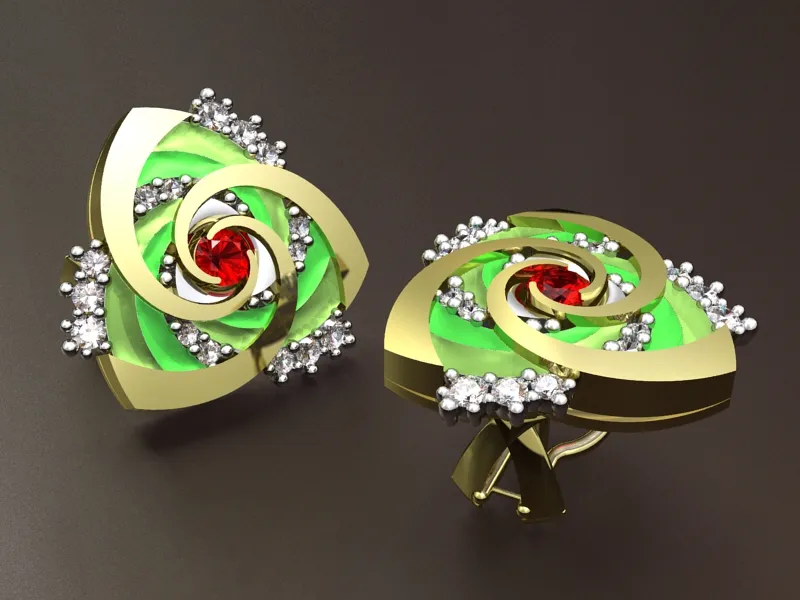
One of the first lessons in any jewelry workshop is forging to the “drop of wax”: gently hammering the rolled sheet to shape a very slight concavity on the outer surface (and a convexity on the inner one). That slight concavity makes the later filing and polishing easier, minimising ripples or “waves”. To avoid rounded edges, a good trick is to cut the surface out a little larger, file it, polish it, and finally trim the edges to the exact size. Then the side, or cut, surfaces are filed and polished. Even with this trick there will always be a minimal rounding of the edges, but no longer of the surface. This rounding of the edge is imperceptible, and it keeps the jewel from becoming an unintended knife.
In the image above, you could cut your finger on that edge. The edge is so sharp that the model looks unreal. And indeed, like any render, it is. Let us compare it with the render of the back surface of the model, once again struck by that fear of mirrors:
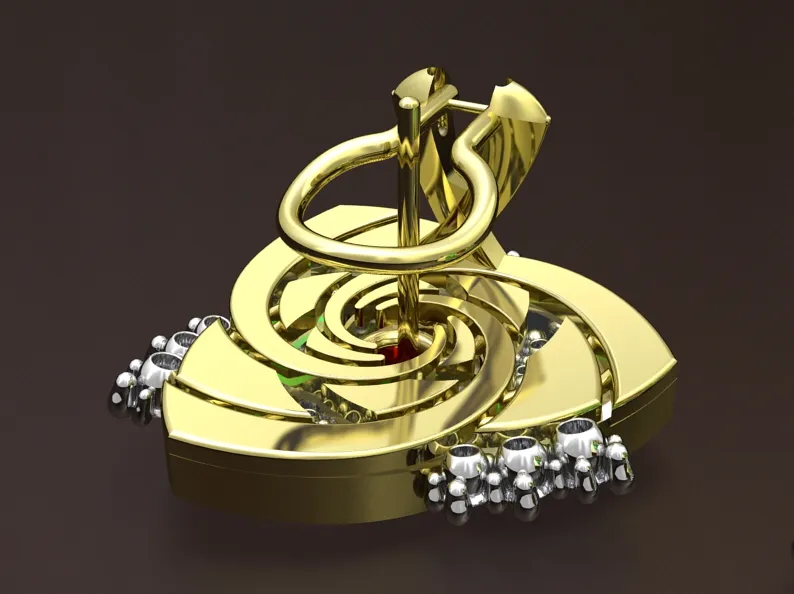
Instead of the “drop of wax”, it has been designed with a cylindrical curvature and rounded edges. Since we are used to mass-produced jewelry that is technically flawed, with rounded edges, the render of this surface looks more realistic.